

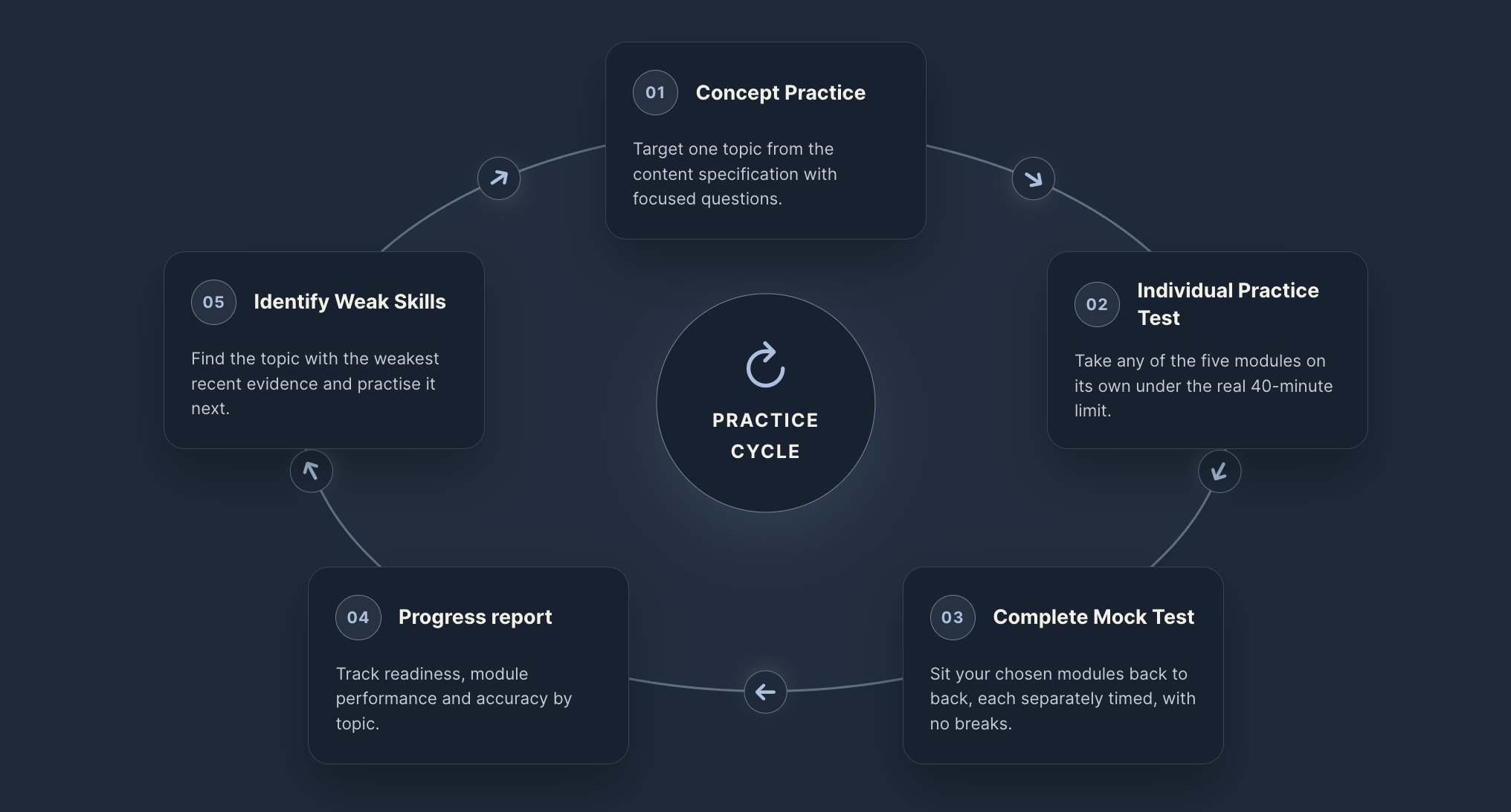
Answering more questions does not always tell you what to practise next. You can become more accurate on familiar topics while leaving other skills untouched. A higher practice percentage may reflect progress, but it does not tell you which parts of the exam you have yet to assess.
ExamPrepIQ connects the steps of focused, informed and purposeful preparation: uncover a gap, learn the method through available course lessons, practise by topic or skill, then return to individual practice tests and complete mocks to assess what has changed.
That structure supports preparation for IELTS, TARA, ESAT, TMUA, LNAT and UCAT.
Why repeated practice can leave gaps hidden
Imagine spending most of your time on the question types you already recognise. You get quicker at them, and your overall accuracy rises. Meanwhile, a topic you rarely select receives little attention. A score calculated from attempted questions cannot tell you how you would perform on that untouched topic.
This is the limitation of practice without a coverage plan. Repetition can consolidate learning, but repeating the same topic mix can leave the same gaps. You need to distinguish skills you have not assessed, skills you are getting wrong, and skills you can answer correctly but too slowly.
ExamPrepIQ makes that distinction actionable. Its Progress Report includes unassessed skills, Concept Practice lets you target a named topic, and the Next-Action Recommendation is built to guide your next step.
A worked example: from a score to a plan
Illustrative TMUA example. You complete a Paper 1 practice test. Algebra errors stand out in the skill breakdown, while another skill is still marked Not assessed.
- Uncover the gap. Review the algebra errors and keep the unassessed skill on your coverage list. They need different actions: strengthen one method and test the unassesses skill.
- Learn the method. Open a relevant lesson in the available TMUA course. Work through the method behind the errors before attempting another set.
- Practise with a purpose. Filter Concept Practice to algebra. Practice those specific questions within a time-limit. A focused Sprint (where you set a focused timer to finish a set of questions) records where your time goes.
- Retest the section. Complete another Paper 1 test with fresh questions where available. Inspect the new algebra evidence and whether the mistakes recur.
- Bring it together in a mock. Rehearse both papers, including pacing. Review the report, assess the untouched skill, and choose the next priority.
You now have something more useful than a question count: a record of what you worked on, how you assessed it and what deserves attention next.
The ExamPrepIQ structure: diagnose, learn, practise, retest
A question bank supplies practice material; a mock rehearses the sitting. ExamPrepIQ connects those activities with learning and skill-level feedback, so a result can lead into a purposeful next session.
Diagnose → uncover gaps → learn → targeted practice → sectional retest → full mock → review progress.
1. Diagnose with an exam-format section
Complete a practice section under the conditions you intend to rehearse. For example, LNAT Section A has 42 questions in 95 minutes. UCAT uses four separately timed subtests, each preceded by a timed instruction screen.
2. See the skills behind the score
ExamPrepIQ's result review shows the skills tagged to questions. The progress report also includes skills without assessed evidence, marked Not assessed, so a missing topic is visible rather than silently absent from your accuracy figure.
Read the statuses as a guide to the evidence: Early signal calls for more practice before a conclusion; Needs attention identifies a priority; Developing, Strong and Review due help you plan continued practice and revision. An unassessed skill is a coverage gap, which means that you need to attempt those questions to understand your accuracy levels.
3. Learn weak topics through the course
A skill report names the problem. Learning the method is the next step. ExamPrepIQ's available courses provide structured lessons you can use to revisit a weak topic before drilling it again. This gives learning a specific purpose: address the gap your practice exposed.
Course coverage and access vary by exam; check your exam page for the available lessons. The same preparation cycle applies across the platform, using the learning resources available for your exam.
4. Practise the skill
Concept Practice turns a broad bank into a focused session. Select the topic or skill your report identified and work on that area. Worked explanations help you understand a solution; favourites and personal notes let you keep useful questions and your own error log together.
Focused Sprints add timing evidence. Review how long individual questions took alongside accuracy. A correct answer that repeatedly takes too long may call for a more efficient method or a different pacing decision.
Concept Practice is the learning stage and does not contribute to readiness. Return to a section test to assess your work. Attempted-question markers help you distinguish revision from fresh practice.
5. Retest and see the change
Return to an individual practice test for the section you have been working on. Fresh questions, where available, help you check whether you can apply the method beyond a familiar example. Then use a complete mock to rehearse the wider sitting and bring section-level preparation together under exam conditions.
Open the progress report with specific questions: Have previously unassessed skills gained evidence? Are errors in the targeted skill becoming less frequent? What does the next recommended action prioritise now?
ExamPrepIQ makes that review visible through skill statuses, recent accuracy and a readiness estimate with confidence and seven-day change. Readiness considers coverage, accuracy, recency and consistency. Interpret the trend alongside the underlying attempts and confidence, rather than treating one number as the whole story.
This is how preparation can build grounded confidence: you can point to the skills you have worked on and the fresh assessment evidence behind your progress.
Leave each report with a next step
The progress report recommends an action from your available evidence: establish a baseline, practise a weak skill, return to a lesson or take a mock. It connects the report to another useful session, reducing the need to plan from a page of numbers.
The value is in the connection between features. A weak skill gives a lesson its purpose; the lesson prepares you for targeted practice; a retest checks the work; the next report helps direct the following session.
Build confidence in what to attempt—and when to move on
Knowing a method is one part of exam preparation. Recognising when a question is consuming too much of your available time is another. Focused Sprints help you identify those patterns before test day.
Use the per-question timing to spot question types that are consistently slow. Practise a more efficient method, then rehearse a move-on decision in a section test or mock. The aim is to protect time for questions you can answer—not simply to rush through more questions.
For multiple-choice sections without negative marking, select your best answer, flag the question and move on if it is taking too long. Return within that section if time remains.
An adaptable four-week plan
Use this example schedule to put the platform into a routine. Adjust it to your starting point, available time and exam date.
Week 1: establish a baseline. Complete a section, review the errors, and record unassessed skills separately. Choose a small number of specific priorities. If you have little time before the exam, focus on the most consequential gaps first.
Week 2: learn and practise. Use a relevant available course lesson, then select the skill in Concept Practice. Examine mistakes with worked explanations. Run a Sprint to review accuracy and timing together.
Week 3: gather fresh evidence. Return to individual section tests with different questions where possible. Compare the skill report and recent change, and assess a previously untouched skill too.
Week 4: rehearse the sitting. Take a mock under the appropriate timing and conditions. Review pacing and mistakes, then choose the next study cycle from the remaining gaps.
Apply the loop to your exam
The common thread is purposeful preparation. The skills, feedback and pacing decisions differ:
- IELTS: separate the four skills and choose Academic or General Training as appropriate. Writing and Speaking need criterion-level feedback as well as practice. Explore IELTS preparation.
- LNAT: analyse Section A reasoning mistakes and practise planning and defending an argument in Section B. Explore LNAT preparation.
- TARA: review Critical Thinking and Problem Solving separately from the Writing Task. Explore TARA preparation.
- TMUA: review mathematical methods and reasoning across Paper 1 and Paper 2, using worked solutions to examine each step. Explore TMUA preparation.
- ESAT: practise the modules required by your chosen course and assess gaps within each one. Explore ESAT practice.
- UCAT: assess accuracy and pacing within each separately timed subtest. Explore UCAT practice.
A checklist you can use with any question bank
- List the topics and skills in the current official specification. Use the relevant UAT-UK resources for TARA, TMUA and ESAT, UCAT test format, LNAT test format or IELTS preparation resources.
- Record what you have actually attempted. Leave an untested skill as “not assessed”; do not record it as 0% or assume you have mastered it.
- Log why you lost a mark. Distinguish a knowledge gap, a reasoning error, a misread instruction and running out of time. Write one thing you will try differently.
- Note whether questions were fresh or familiar. Repeated questions are useful for review, but recognition can make progress look stronger than it is.
- Choose a focused next session. Learn or review the method, practise it, then check it on fresh questions under the relevant section conditions.
Frequently asked questions
How is ExamPrepIQ different from a question bank?
ExamPrepIQ connects skill-level diagnosis, available course lessons, topic-based Concept Practice, timed Sprints, individual tests and complete mocks. The report highlights assessed weaknesses and unassessed areas, then recommends a next action. You get a structure for choosing, doing and reviewing your preparation. Explore practice for your exam.
How do I distinguish a weak skill from an unassessed one?
A weak skill has evidence of mistakes; an unassessed skill has no evidence yet. Test the unassessed skill before drawing a conclusion, and use several questions to check whether an apparent weakness is consistent.
Should I repeat questions I have already answered?
Yes, for reviewing a method or revisiting mistakes. Mark them as repeats and use fresh questions where possible to assess transfer. Remembering a solution can help learning without proving you can solve a new question independently.
What does ExamPrepIQ cost?
Every exam is free to start. Current access, paid options and learning resources vary by exam; check Plans & Pricing and the app before choosing a plan. AI grading applies to IELTS Writing and Speaking, LNAT essays and TARA writing, with allowances and coin costs shown in the app. TMUA has no AI-graded written component. IELTS Academic and General Training are separate paid plans. See Plans & Pricing.
How will I see whether targeted practice is helping?
Retest with a section test, then review the new skill evidence, accuracy and readiness trend alongside confidence. Use complete mocks to check how that preparation comes together across the sitting. Look for a pattern across attempts and follow the next priority your report identifies.