

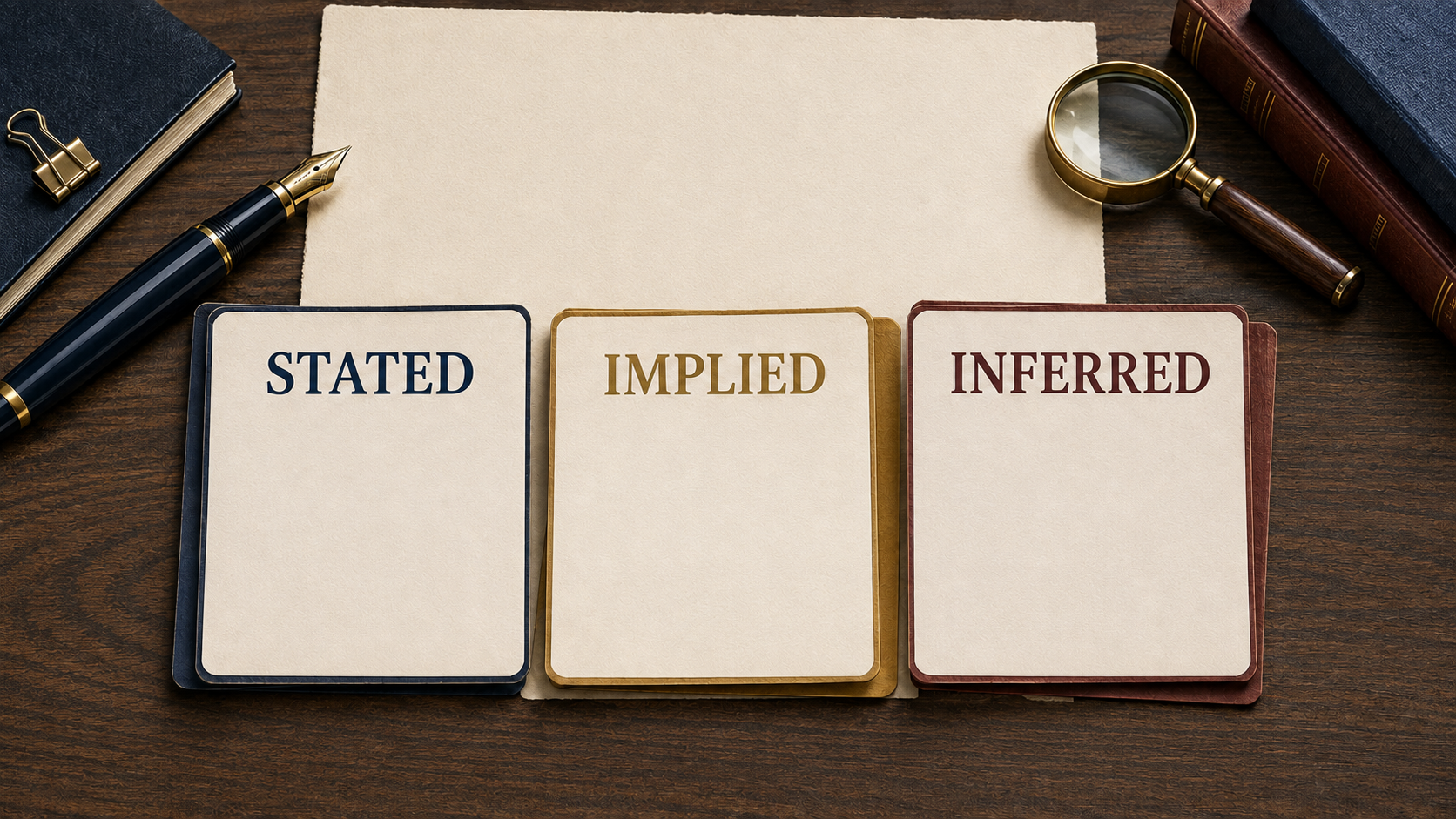
An LNAT answer can be supported without appearing word for word in the passage. It can also sound completely reasonable and still have no support at all.
Learning the difference between stated, implied and inferred helps you tell those cases apart. To put it simply, stated information is what is explicitly mentioned in the text. Implied meaning is what the text says without saying it directly. Inference is same as implied, the only difference is a text or a passage implies something, while the reader infers the same. The subject matter is the same.
Stated, Implied and Inferred: The Key Differences
| Term | Meaning | What you need to show |
|---|---|---|
| Stated | The text explicitly expresses the information. | A sentence or accurate paraphrase that says it. |
| Implied | The wording or argument communicates something without saying it directly. | The contextual evidence that supports that meaning. |
| Inferred | The reader draws a conclusion from the information supplied. | A justified reasoning step, not an added factual assumption. |
A stated answer need not copy the passage. If the text says “The proposal received no support from committee members”, then “No committee member supported the proposal” is an explicit claim expressed differently.
Let's better understand the difference using a few examples.
Example 1: What Is Stated?
- Passage
The museum admitted visitors without charge on Sundays during August. Weekday admission fees remained unchanged.
- Question
Which statement is explicitly supported?
- A. The museum was free to enter throughout August.
- B. Visitors paid no admission fee on Sundays during August.
- C. Sunday attendance increased during August.
- D. Weekday admission was expensive.
Answer: B. “Without charge” and “paid no admission fee” express the same information.
A extends a Sunday policy to every day. C adds an attendance result. D turns an unchanged fee into a judgement about its size. None of those additions is supplied by the extract.
Check scope before matching vocabulary. An option can repeat “August” and “admission” while changing the meaning.
Example 2: What Does the Writer Imply?
- Passage
The council calls its consultation accessible to all residents. Yet every meeting takes place during working hours, and residents cannot submit comments in writing.
- Question
Which view does the writer imply?
- A. The consultation arrangements may prevent some residents from contributing.
- B. No resident can attend a meeting.
- C. The council deliberately wants to silence opposition.
- D. Written submissions are always better than meetings.
Answer: A. The contrast introduced by “Yet”, followed by the two restrictions, challenges the council's accessibility claim. That is the contextual basis for the implication.
B claims universal exclusion. C invents a motive. D introduces a general preference. The writer can question the arrangements without making any of those stronger claims.
Notice whose words you are reading. “Accessible to all residents” is the council's description; the author is questioning it. Attributing a quoted claim to the writer can reverse the answer.
Example 3: What Can You Infer?
- Passage
Every application received before noon was reviewed that day. Application R was not reviewed that day.
- Question
Which conclusion must follow?
- A. Application R was received before noon.
- B. Application R was not received before noon.
- C. Application R arrived the next morning.
- D. Application R was rejected.
Answer: B. If R had been received before noon, the first sentence requires it to have been reviewed that day. The second sentence rules that out.
C supplies an exact arrival time that is not established. D confuses being reviewed with being accepted or rejected. B follows from the relationship between the two sentences, even though neither states B directly.
Now reverse the second sentence: suppose R was reviewed that day. You could not conclude that it arrived before noon. The passage does not say that only early applications received same-day reviews. Reversing a one-way condition creates an unsupported inference.
Example 4: A Qualified Claim Is Not a Guarantee
- Passage
In the survey, commuters said that safe and convenient cycle routes would make them more willing to cycle. The author argues that improving routes is likely to encourage cycling more effectively than an advertising campaign alone.
- Question
Which statement best reflects the author's position?
- A. Advertising never changes travel choices.
- B. Better routes will make every commuter stop driving.
- C. Improving cycle routes is likely to be more effective than advertising alone at encouraging cycling.
- D. Most commuters already prefer cycling to driving.
Answer: C. It preserves the comparison and the word “likely”. A changes a relative judgement into “never”. B turns a probability into a guarantee about everyone. D invents a current preference.
This answer is a paraphrase of an explicit conclusion. It is supported, but it would not fit a question specifically demanding something implied but not stated. Evidence and task wording both matter.
Common LNAT Inference Traps
| Trap | Unsupported change | Better check |
|---|---|---|
| Scope expansion | Some participants becomes all participants. | Which group does the passage identify? |
| Certainty inflation | May help becomes will help/solve the issue. | How confident is the original claim? |
| Invented causation | Two things occur together, so one caused the other. | Is a causal connection established? |
| Added motive | A decision was made, so the decision-maker wanted a particular outcome. | Does the text explain the intention? |
| Outside knowledge | A familiar fact fills a missing premise. | Can I justify this with evidence from the passage ? |
For more examples of that last mistake, read why outside knowledge can hurt your LNAT score. Familiarity with a subject should prompt closer checking of the wording.
Implication, Assumption and Main Conclusion
These concepts answer different questions about an argument.
Consider: “The college should extend library opening hours because students with evening classes need somewhere to study afterwards.”
The main conclusion is the recommendation to extend opening hours. One assumption connecting the reason to that recommendation is that extending those hours would give the students access to a place to study. An inference is a conclusion you draw from what the text supplies.
An argument's unstated assumption need not have been proved true by its evidence. Avoid treating every possible assumption as an established fact. Also avoid assuming that every inference you can make is the author's main point. Our guide to identifying the main conclusion in an LNAT passage explains how to trace what supports what.
A Practical Evidence Checklist
- Read the exact instruction. Identify whether it asks about explicit wording, implied meaning or a conclusion drawn from evidence.
- Find the relevant sentences. Include context and check whether the author is speaking or reporting another person's view.
- State the evidence neutrally. Preserve restrictions on people, time and certainty.
- Explain the reasoning step. If the option is not explicit, show how the evidence supports it.
- Challenge additions. Look for an invented fact, motive, cause or universal claim.
- Compare the final candidates. Prefer the answer that fits both the evidence and the question, rather than the one with the most familiar words.
Frequently Asked Questions
Are implied and inferred the same thing?
They are closely related. A writer implies a meaning; a reader infers it. The distinction identifies who communicates or draws the conclusion, rather than automatically marking different levels of certainty.
Does a stated answer have to use the passage's exact words?
No. An accurate paraphrase can report explicit information. Check whether it preserves the original meaning, including scope and qualifications.
Can I infer something that is probably true in real life?
Only if the passage supports the inference to the standard the question asks for. Real-world plausibility alone is insufficient. A new fact needed to bridge the gap is a warning sign.
Should I always reject words such as “all” or “never”?
No. Reject an absolute claim when the evidence does not support it. If the passage establishes a universal rule, an absolute conclusion may be justified.
Official guidance and linked resources checked on 6 September 2026.