

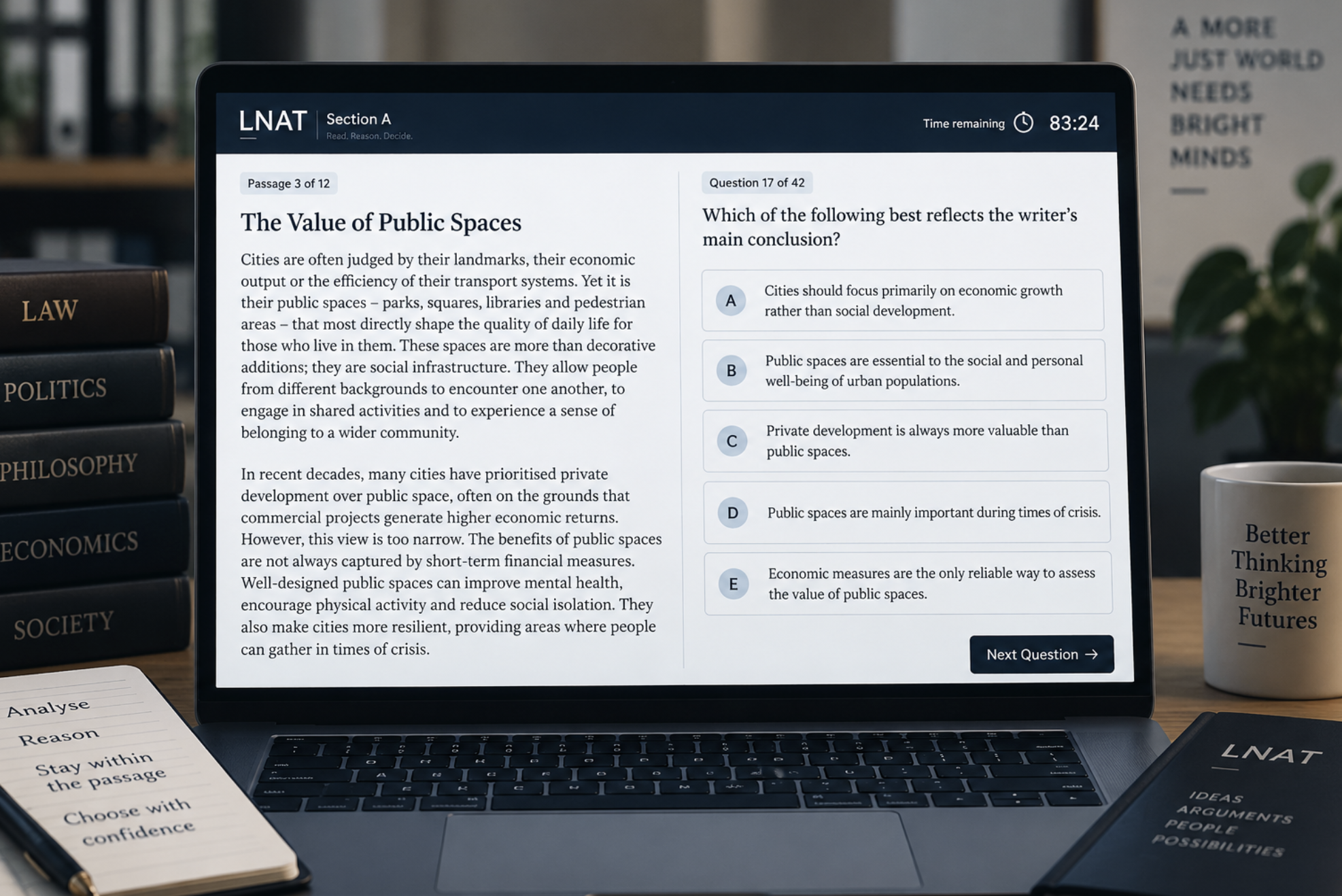
Knowing more usually helps in an exam. In LNAT Section A, it can tempt you to select an option that may be generally true but is not mentioned in the passage or does not answer the question.
The key distinction is what you know about the topic versus what the passage supports. A sensible opinion, a remembered statistic or a familiar explanation cannot substitute for evidence in the text.
The official LNAT hints and tips tell candidates to base multiple-choice answers on the passage, without relying on information from other sources. Even false statements should be accepted for the purposes of the test. This guide turns that advice into a practical reading habit.
Why Outside Knowledge Is Dangerous in LNAT Section A
The official test format gives you 95 minutes for 42 multiple-choice questions across 12 argumentative passages. For the full structure, see our LNAT syllabus and exam format guide.
When a topic feels familiar, it is easy to supply a missing step without noticing. You read “sales fell after the change” and remember an explanation from an economics lesson. You read a policy argument and answer with the policy you favour. In both cases, the extra information changes the task you are solving.
Three distinctions help keep LNAT reading comprehension precise:
| Distinction | Ask yourself |
|---|---|
| Writer's position vs my position | Am I reporting the argument or agreeing with it? |
| Supported vs plausible | Does this follow, or could it merely be true? |
| Exact claim vs stronger claim | Has the option added certainty, scope or a cause? |
Example 1: Passage Truth vs Real-World Truth
- Passage
Every town in the survey that introduced a pedestrian zone reported lower retail sales the following year. The writer therefore opposes extending the scheme.
- Question
According to the passage, what happened in the surveyed towns that introduced pedestrian zones?
- A. Retail sales rose because shopping became more pleasant.
- B. Retail sales fell the following year.
- C. Retail sales were unchanged.
- D. Some reported increases and others reported decreases.
Answer: B. It restates the reported result. A and D might sound reasonable if you have read about successful pedestrian schemes elsewhere, but neither matches this extract. C contradicts it.
Notice the boundary: the passage refers to towns in a survey. It does not establish what happens in every town worldwide. Nor does reporting the writer's opposition require you to endorse it.
If the question instead asked about the reasoning, you would examine whether the reported result supports the conclusion.
Example 2: Correlation Does Not Establish Causation
- Passage
In a survey of commuters, people with discounted monthly tickets used public transport more often than people without them.
- Question
Which statement is supported?
- A. Buying a discounted ticket caused commuters to travel more often.
- B. Discounted-ticket holders in the survey used public transport more often.
- C. Discounted tickets reduced car use across the city.
- D. Every commuter would use public transport more if tickets were cheaper.
Answer: B. The extract reports an association. A adds a causal direction: frequent travellers might be more likely to buy monthly tickets in the first place. That possibility shows why the inference is insecure; it is not a new fact we should assume.
C introduces car use, which was not measured in the extract. D expands a surveyed relationship into a prediction about everyone.
The same caution applies to “after”. If a passage says usage rose after a price reduction, timing alone does not establish why it rose. Look for evidence connecting the proposed cause and effect.
Example 3: A Plausible but Unsupported Distractor
- Passage
The library extended its opening hours during examination month. Evening visits increased, while the number of books borrowed remained unchanged.
- Question
Which conclusion follows from the passage?
- A. Students achieved higher examination marks.
- B. The library bought more textbooks.
- C. Evening visits increased without an increase in book borrowing.
- D. Visitors preferred studying alone to studying in groups.
Answer: C. It combines the two reported outcomes without adding a new claim.
A is attractive because extra study time might help students. But the passage gives no examination results and does not identify all visitors as students. B invents a purchasing decision. D invents a preference.
“That would make sense” is a reason to investigate an option, not evidence that it is correct.
Example 4: The Familiar-Topic Bias
Passage:
The author supports using automated software to schedule hospital appointments, but argues that decisions about treatment should remain with clinicians.
Suppose you follow debates about artificial intelligence. You might expect the writer to argue either for automation everywhere or against it altogether.
Neither summary fits. The position is limited: support for scheduling software, with a boundary around treatment decisions. An answer saying “the author opposes automation in hospitals” loses that distinction.
For familiar subjects, deliberately identify the qualification before evaluating the options. Words such as “but”, “some” and “only” can carry the part of the argument your expectations overlook.
How to Answer LNAT Inference Questions Without Adding Facts
An inference does not need to repeat a sentence verbatim. It must have a defensible connection to the information supplied.
Consider:
Every proposal approved by the committee receives a second review. Proposal X did not receive a second review.
It follows that Proposal X was not approved by the committee. Otherwise, the first statement would require a review. That deduction uses the relationship in the extract.
By contrast, “Proposal X was too expensive” supplies a possible explanation with no evidence. “Proposal X will never be approved” adds a prediction.
For LNAT inference questions, match the strength of the answer to the evidence and the wording of the question. “Most strongly supported” requires comparing support; it is not an invitation to select the most familiar explanation. These are practical reading distinctions, not a separate official classification of LNAT questions.
For a closer look at the evidence behind an answer, read stated vs implied vs inferred in LNAT questions. When the task asks for the author's central claim, our guide to identifying the main conclusion in an LNAT passage shows how to separate that claim from its supporting reasons.
A Five-Step Checklist for Staying Inside the Passage
Use this method during practice until you can apply it without a lengthy pause:
- Identify the task. Is the question asking for the writer's view, an inference, an assumption or an assessment of the reasoning? Read any conditions it supplies.
- Locate the evidence. Return to the relevant sentence and its context. Check who is speaking: the author may be quoting an opponent.
- Paraphrase neutrally. Write or mentally state the claim without correcting it or making it more persuasive.
- Check each addition. Look for a new cause, group, time period, motive or degree of certainty in the options.
- Justify your choice. Complete: “This answers the question because the passage says…, which supports…”. If the missing step is a remembered fact, reconsider.
For questions that supply a hypothetical condition, use that condition as directed. Staying within the task means using the passage and the question's instructions while applying ordinary language understanding and logical reasoning.
Turn Each Mistake into a Useful Practice Note
After a passage set, record why your chosen answer attracted you. A short error log is more useful than copying the correct letter:
| What went wrong | Example note | Next-time check |
|---|---|---|
| Corrected the writer | I answered with a policy result I had read elsewhere. | Separate the reported claim from my knowledge. |
| Added a cause | I treated an association as proof of an effect. | Identify what establishes the causal direction. |
| Filled a gap | I assumed library visits improved marks. | Find evidence for each new claim. |
| Missed a qualification | I turned limited support into total opposition. | Restate the qualification before choosing. |
Start with the official LNAT practice tests, which include an online sample and downloadable papers, commentary and a marking scheme. Review both your wrong answers and correct answers you could not confidently justify.
For additional practice, explore ExamPrepIQ's LNAT practice options or open LNAT practice and apply the same evidence check to your next passage set. ExamPrepIQ is an independent preparation resource and is not endorsed by the LNAT Consortium.
Wider Reading and International Students
Keep reading beyond practice passages. The official LNAT preparation guide recommends reading quality English-language newspapers and examining assumptions, conclusions and counterarguments. Use that reading to practise analysing arguments, rather than memorising facts to insert into Section A answers.
For international applicants, the same approach avoids importing assumptions from a different legal, political or educational system. Use a term as the passage defines it. If a topic is unfamiliar, map the author's claim and reasons before deciding that specialist background knowledge is missing.
Our LNAT preparation guide places close-reading practice alongside timed work and essay preparation. Wider reading develops your ability to follow an argument; passage-based practice teaches you to justify an answer from the evidence supplied.
Frequently Asked Questions
Can a factually true statement be a wrong LNAT answer?
Yes. It can be true but unsupported by the passage, or fail to answer the particular question. Example 3 shows how a plausible benefit can become a distractor when the extract provides no evidence for it.
What if I know the passage contains a false statement?
Follow the official Section A guidance: accept the passage's information for the test. You can still evaluate the logic when the question asks you to do so.
Is logical deduction the same as using outside knowledge?
No. A deduction connects information supplied in the task. Outside knowledge introduces an additional factual premise, such as an unmentioned policy effect or motive. The committee example above demonstrates the difference.
Should I stop reading the news while preparing for LNAT?
No. Use wider reading to practise following and questioning arguments. During a specific Section A question, keep your answer anchored to its passage. Section B is a different task: constructing and defending an argument of your own.
Official guidance and linked resources checked on 6 September 2026.